

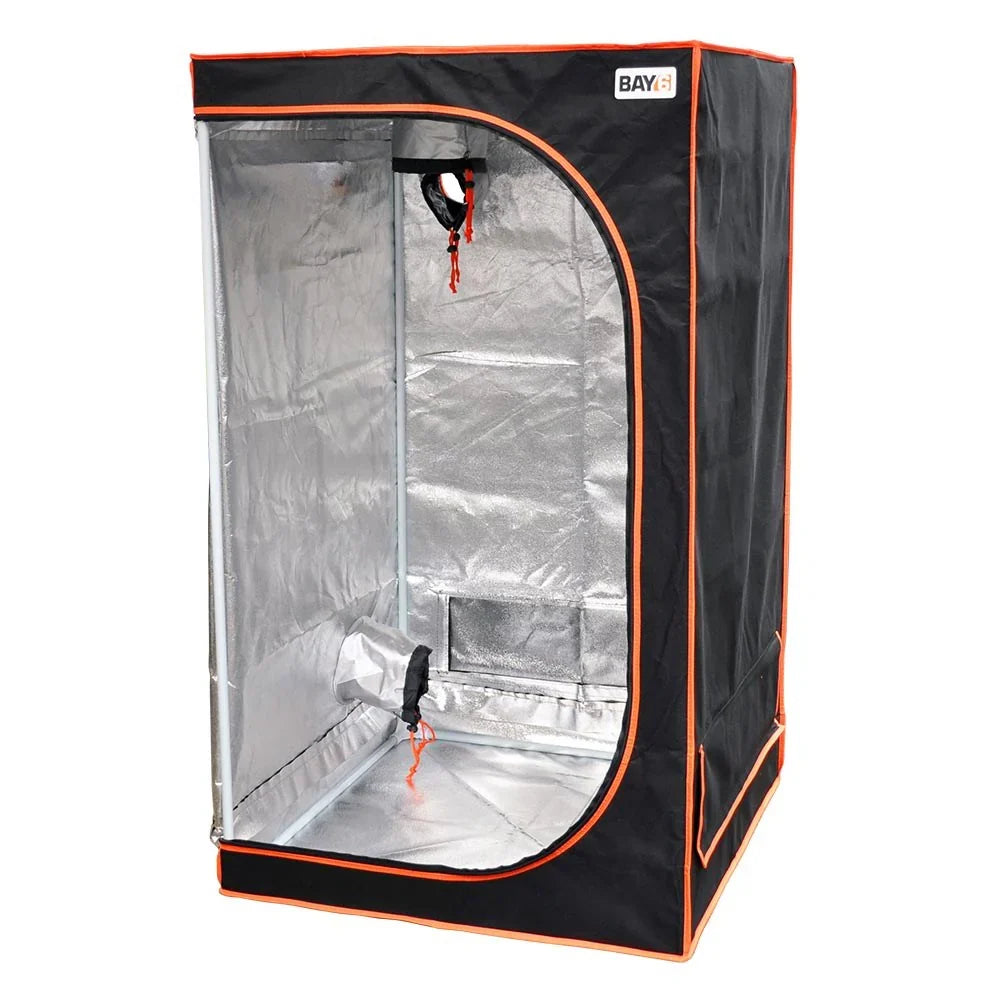
Quick answer: To set up a grow tent, choose a level spot near a socket, build the frame and fit the cover, then check for light leaks. Hang your grow light from the roof bars on rope ratchets, fit your extractor fan and carbon filter at the top, run ducting out of a top port and leave a lower vent open for fresh air. Add a clip fan, a timer and a thermometer-hygrometer, then run everything empty for a day or two to check temperature and humidity before any plants go in.
A grow tent gives you a controlled space for growing tomatoes, chillies, herbs, salad, strawberries and houseplants indoors all year round. Setting one up is not difficult, but doing it in the right order saves a lot of reaching around, re-hanging and frustration. Here is how we set tents up, step by step.
What you will need
- A grow tent. See our grow tents range.
- A grow light, usually an LED. Browse our LED grow lights.
- An extractor fan, carbon filter, ducting and clips.
- Rope ratchets to hang the light and filter.
- A clip fan for air movement.
- A plug-in timer for the light and a thermometer-hygrometer.
- A multi-socket extension lead and some cable ties.
If you would rather buy it all in one go, our grow tent kits put a tent and a matched light together, which takes the guesswork out of sizing.
Step 1: Choose the right spot
Pick a flat, level floor with a little room around the tent so you can open the doors fully and reach the ports. A spare room, loft, garage or cellar can all work. Think about:
- Power: a nearby socket, so leads are not trailing across walkways.
- Temperature: very cold spaces like garages in winter will need heating. Our guide on keeping a grow tent warm in winter covers this.
- Where the air goes: your extractor needs somewhere to vent, ideally out of the room through a window or vent, or at least away from the intake.
- Water: spills happen, so avoid carpets you care about or put down a waterproof sheet.
Step 2: Build the frame and fit the cover
Lay out the poles and connectors and check them against the instructions. Most tents go together the same way: build the base, add the uprights, then the roof bars. Many tents are easier to cover if you put the cover over the frame before adding the final roof bars, so read your tent's instructions first.
Once the cover is on, zip up all the doors and pull the corners square. A tent that sits square zips more easily and keeps its shape under load.
Check for light leaks
In the daytime or with the room lights on, step inside, zip the doors up behind you and look for pinholes or gaps of light around the zips, seams and ports. Any light getting in or out is worth fixing. Small holes in the fabric can be patched with tape.
Step 3: Hang the grow light
Hang the light from the roof bars using rope ratchets so you can raise it as plants grow. The Krystal ratchets we sell are rated to 68kg per pair, which comfortably covers a typical LED. Keep the light level so it spreads evenly over the canopy.
For the starting height, follow the light manufacturer's guidance. Every light is different, so there is no one number to use. If you are still choosing a light, our guide on what size LED grow light you need will help.
Step 4: Fit the extractor fan and carbon filter
Warm air rises, so extraction goes at the top of the tent. The usual layout is:
- Hang the carbon filter from the roof bars with rope ratchets, inside the tent.
- Connect the extractor fan to the filter, either directly or with a short length of ducting. The fan pulls air through the filter.
- Run ducting from the fan out through a top port and away from the tent.
- Secure every joint with a duct clip so nothing works loose.
Keep ducting runs as short and straight as you can. Every bend and extra metre makes the fan work harder. You will find fans, filters and ducting in our fans and filters range, and there is more detail in our guide to choosing an extractor fan and carbon filter.
Fresh air in
Open a lower vent or port on the opposite side to your extraction. As the fan pulls air out at the top, fresh air is drawn in at the bottom. The tent walls should pull in slightly when the fan is running; if they puff out, you are pushing air in rather than pulling it out.
Step 5: Add a clip fan
A clip fan on one of the uprights keeps air moving around the leaves. This helps to avoid hot spots and damp, still air, which mould likes. Angle it across the tent rather than blasting directly at plants.
Step 6: Sort out power and timers
- Plug the grow light into a timer so it switches on and off at the same time every day.
- Keep plugs and extension leads off the floor and away from where you water.
- Tidy cables with ties and run them through the tent's cable ports.
- Do not overload sockets. Check the rating on your extension lead against everything plugged into it.
Step 7: Do a test run
Before any plants go in, run the tent empty for a day or two with the light on its timer and the fans running. Put a thermometer-hygrometer at plant height and check readings with the light on and off. This is the point to fix problems: if it is too hot, raise the extractor speed; if it is too cold at night, look at heating. A heater or climate controller can help in a cold room.
Step 8: Move your plants in
Once temperatures are steady, put a tray or saucers on the floor, add your plants and start them with the light at the height the maker recommends. Check them daily for the first week and make small changes one at a time.
FAQs
How long does it take to set up a grow tent?
Most people can build a small or medium tent in an hour or two. Allow extra time for hanging the light, fitting the extraction and doing a test run before plants go in.
Does the carbon filter go inside or outside the tent?
It normally hangs inside the tent at the top, with the fan pulling air through it and pushing it out through the ducting. Some growers mount the fan outside to save space, which also works.
Do I need a carbon filter?
It is not essential for every crop, but it is useful if smells from soil, compost or flowering plants would bother you. Tomato plants, for example, have a strong scent. Many tents come with one in a kit.
Can I set up a grow tent in a garage?
Yes, as long as you have safe power and can keep it warm enough. Unheated garages get cold in a UK winter, so plan for a heater and check temperatures overnight.
Get it set up right first time
If you would like a hand choosing parts or want to check your plan, call into our shop at Unit 2 Black Lake, West Bromwich, B70 0PJ. You can also ring 0121 553 7872 or WhatsApp us. We offer free UK delivery over £94.99 and price match on what we stock.